
 Series: Exec Brief
 📄 Transcript
Welcome to this explainer. I am absolutely thrilled to have you here today. Look, if you are tuning into this, you're someone who values efficiency, structure, and most importantly, strategic clarity.
Today, we are looking at something that is literally going to change how you view enterprise governance. We're unpacking the eGRACS Framework, and I'm serving this up as your ultimate blueprint for executive strategic clarity. Let's get right into it.
Okay, let's dive into this. I want you to consider this guiding principle. Governance shouldn't be a burden.
It should be the backbone of your success. You know, in so many modern enterprises, compliance has just completely devolved into this tangled web of disconnected spreadsheets. It restricts your business growth.
It slows down innovation. Governance is supposed to be the structural foundation that empowers you to move faster and with way more confidence. But somewhere along the line, it just became a heavy anchor.
I mean, picture this scenario. An audit report drops or a regulator suddenly changes the rules. Immediately, across the entire organization, someone yells, do we have a control for this? And what happens next? Complete chaos.
It's this stressful, reactive fire drill where your enterprise governance is essentially held together by duct tape, coffee, and cross fingers. We end up treating compliance like a frantic scramble rather than a deeply integrated strategy. Let's be honest.
It is an incredibly expensive and exhausting way to run a business. Now, I know your time is incredibly valuable. So here is a quick boardroom-ready flight path for our explainer today.
We'll start with the illusion of control, move into unifying the compliance multiverse, and then unpack the core of the eGRACS Framework, the golden triangle ecosystem. From there, we'll scale up with the fractal hierarchy, bridge theory to reality, and finally, lock in on achieving strategic clarity. We are going on a journey from siloed chaos to a unified architectural solution.
Let's kick things off with section one, the illusion of control. We really need to address how traditional compliance frameworks are treated as static burdens rather than strategic assets. When organizations try to implement multiple standards out of the box, you know, things like ISO, PCI DSS, or COBIT, they end up creating what we can only describe as entirely separate universes.
You've got risk reports sitting in one silo, compliance templates buried in some forgotten SharePoint folder somewhere else, and cybersecurity is just stuck in the middle trying to play referee. It creates massive operational bloat. These fragmented, endless checklists lead to redundant efforts, and frankly, expensive confusion.
Everyone in the boardroom talks about alignment, but nobody is actually experiencing it on the ground. Which brings us to section two, unifying the compliance multiverse. This is where the eGRACS Framework fundamentally flips the script.
Just notice the stark contrast here. On one side, we have the old way, control inventories. Think flat, static, incredibly rigid checklists.
They're totally fragmented. Now contrast that with a unified control architecture. eGRACS takes the very best elements of about two dozen global standards and fuses them into a unified, cohesive set of just 120 ICT controls.
It's dynamic, it's interconnected. This means your risk register, your security controls, and your audit tasks all flow from the exact same core system. They inform each other automatically.
It becomes your true single source of truth. All right, moving to section three, the golden triangle ecosystem. Now what's really interesting here is the number 40.
Out of those 120 unified controls we just talked about, eGRACS organizes them into 40 distinct golden triangles. These 40 micro ecosystems are literally the foundational building blocks of the entire architecture. So what does this actually mean for your resilience? A golden triangle micro ecosystem places three interdependent controls at the vertices of a triangle.
Think of it like architectural scaffolding. If you just stack bricks straight up on top of each other, a strong enough wind will easily knock them right down. But when you use a triadic triangular scaffold, you're creating load-bearing beams that perfectly distribute weight and stress.
When regulatory pressure hits, the structure bends, it flexes, but it absolutely does not break. And this brilliantly illustrates why that specific triadic design is so wildly powerful. Because the controls are interdependent.
If a brand new regulation drops and you have to adjust one control, the other two automatically adapt to that new context. It is incredibly similar to a biological ecosystem adapting to its environment. If one node faces pressure, the rest of the ecosystem shifts to support it, creating this stabilizing ripple effect.
This adaptive resilience means you maintain a perfectly balanced focus. No single aspect of your governance is ever neglected. Now that we have our building blocks, let's look at section four, scaling the fractal hierarchy.
We need to see how these 40 micro ecosystems actually scale up to support massive global operations. eGRACS arranges these triangles into a highly intuitive four-tiered fractal hierarchy. At the very top, the core tier has just three foundational controls, setting the overarching vision.
This naturally scales down to nine strategic, 27 operational, and finally 81 tactical controls for your day-to-day hands-on execution. Because it's fractal, it scales fluidly. Just imagine a tree naturally expanding its branches as it grows.
The Framework expands precisely to match your enterprise's exact complexity. You are always right-sized, whether you're a fast-moving startup or a massive Fortune 500 company. Section five, bridging theory to reality.
Having a high-level architecture is fantastic in theory, but how do we translate this abstract structural scaffold into actionable processes on the ground? Well, eGRACS offers flexibility, but for large enterprises, the absolute goldmine of value is found in the hybrid implementation. This approach is phenomenal. It acts as a simultaneous diagnostic and design scaffold.
So you can have your board-level leadership driving top-down strategic vision from the core tier, while at the exact same time, your IT teams are doing bottom-up transformation, fixing processes right in the trenches at the tactical tier. Board-level vision actively meets tactical execution simultaneously without ever losing that crucial structural integrity. To make that hybrid execution actually work in the real world, the eGRACS Model acts as your contextual bridge.
It translates all 120 of those controls into your specific industry language using three very tangible pillars. First, you have practices, which tailor the controls to specific, strict regulations like HIPAA or GDPR. Then you have templates, giving you pre-designed policies.
And finally, SOPs, which give your team step-by-step ground-level instructions. This completely eliminates the guesswork. It ensures compliance isn't just some generic bolt-on, but a true part of your organizational DNA.
Which brings us to our final section, achieving strategic clarity. This right here is the ultimate payoff for the C-suite. We are fundamentally reframing governance from a restrictive compliance cage into a dynamic engine for real return on investment.
This Framework proactively ends the era of the reactive fire drill. Through a process called continuous normalization, as global laws change out there, eGRACS seamlessly maps and updates your entire internal system. Dynamic feedback loops constantly evaluate your real-world performance, so your governance stays perfectly tuned to your company's specific beat.
And because the whole shebang is unified, you finally get integrated board dashboards. You get a single, undeniable source of truth that absolutely eliminates redundant compliance bloat and administrative waste. I wanna leave you with a final provocative thought to mull over today.
Take a hard look at your current systems and ask yourself, is your governance a cage or is it the structure that sets you free? When you implement a truly dynamic, interconnected control architecture like eGRACS, governance stops being a burden. It becomes the exact structural foundation that empowers your enterprise to innovate safely, scale effortlessly, and navigate complex global regulations with total strategic clarity. Thank you so much for joining me on this explainer.
Keep learning, keep structuring for success, and I will see you next time.
 Series: Exec Brief
 📄 Transcript
Today, we're diving headfirst into a high-tech exploration of governance and compliance. Now we are going to look at exactly how the eGRACS framework takes what is, let's be honest, usually a totally brittle, painful compliance exercise and completely transforms it into a sleek automated machine.
Seriously, if you've ever sacrificed a weekend to updating exactly who is responsible for what in some massive organizational spreadsheet, while you know, it can be an absolute nightmare. But we've got some really fascinating source material today that outlines a completely different, highly structured way out of that mess. Okay.
So let's jump right in by looking at a major pain point. Why did traditional Rossi matrices, you know, those charts tracking who's responsible, accountable, consulted, and informed, why do they inevitably fail during a regulatory audit? Well, just think about it for a second. Manual RACI charts are flat, static spreadsheets, right? The moment someone gets promoted or leaves the company or shifts departments, boom, the chart breaks.
You're left with orphans controls and gaping compliance holes. And auditors absolutely hate that. It just creates a massive amount of friction and risk for the business.
So here is our roadmap for today. Think of this like a sleek system boot sequence. First, the regulatory problem.
Second, mapping tiers to enterprise practices. Third, a really cool fast heuristic. Fourth, the cascade in action.
And finally, automating identity. All right. Kicking things off with section one, the regulatory accountability problem.
Listen, modern prudential regulators are not messing around anymore. Frameworks like APRA CPS 232, or the ISO 380-500 standard. They demand something super specific.
They require that board level oversight and executive level execution remain demonstrably distinct. Basically overlapping accountability is a massive red flag. If a regulator looks at your structure and cannot definitively tell where the board's mandate ends and the C-suites execution begins, well, you fail the audit.
This is exactly why a new structural approach, one that doesn't just rely on flat, easily broken spreadsheets is absolutely crucial moving right along to section two, mapping tiers to enterprise practices. This is where we completely abandon the flat spreadsheet for a multi-layered fractal hierarchy. It's called the eGRACS cascade.
We're looking at a four tiered hierarchy that interfaces perfectly with three distinct enterprise practices. Starting right at the top. The governance practice handles strategic oversight and policy.
This covers tier one, which is the core tier for foundational objectives signed off by the board. And tier two, the strategic tier for focus areas owned by the C-suite. Moving down a level, the management practice handles operational planning, meaning our tier three operational tier owned by directors and IT managers.
And finally, at the very bottom, the administration and execution practice handles technical implementation. That's the tier four tactical tier owned by engineers and system admins. By structuring things this way, eGRACS literally permanently solves the accountability overlap.
So going back to what the regulators want, the crucial point here is how this directly satisfies those strict expectations, eGRACS forces a strict, undeniable separation. Core tier one is strictly the board mandate. These are the foundational objectives, policies, and risk appetites.
Meanwhile, strategic tier two is the executive translation. This is where the C-suite takes the board's mandate and expands it into enterprise strategies and roadmaps. The accountability is mathematically and structurally separated, making it completely crystal clear to any auditor exactly who owns the policy versus who owns the strategy to actually achieve it.
All right. Section three, the practitioners fast heuristic. Okay.
Honestly, this is probably my favorite part of the eGRACS framework because it introduces a brilliant mental shortcut for everyone on the ground. Instead of desperately hitting control plus F on some massive broken racy chart to figure out your job, a practitioner gets what is essentially a glowing heads up display. What tier is this? That tells me what document type I owe.
It is that simple. If you're working at tier one, you owe a policy. If you're at tier two, you owe a strategy document or roadmap.
At tier three, you owe an operational programmer plan. And if you're down at tier four, you owe technical standard operating procedures, SOPs, and system configs. It simplifies control responsibility immensely and just gives incredible visibility across the whole enterprise.
Let's see this in action. Section four, the accountability cascade. Let's take this out of theory for a second and see how a single foundational pillar tracks all the way down the enterprise.
Let's look at the managed demand control. At tier one, the board of directors owns the policy. They sign off on the board ICT governance policy.
At tier two, the CIO translates that into strategy, delivering an enterprise security and assurance carter. At tier three, the information security manager takes that strategy and turns it into an operational plan, producing the system security program and incident response plan. And finally, at tier four, the SOC engineer executes the tactical safeguards, writing the actual SOPs and firewall configs.
The lineage of sign-off flows totally seamlessly from the boardroom directly down to an engineer's firewall rules. Let's look at another example to see how this scales across completely different departments. Take the deliver solution control.
At tier one, the CTO owns the technology solution delivery strategy in the capital budgets. At tier two, the head of solution delivery creates the enterprise implementation roadmap. At tier three, the release manager builds the solution release plan.
And at tier four, the DevOps engineer handles the CI/CD pipeline configs and infrastructure as code scripts. Now really think about this for a second. We have literally linked executive capital budgets directly down to DevOps Git commits with zero ambiguity about who is accountable at every single step.
Finally, section five, automating with global identity. So this is where our theoretical blueprint is brought to life using some really cutting edge automation. Remember how we started this explainer talking about how manual racy matrices break when people change jobs? Well, the old way is to hard-code static names, like saying John Doe owns this control.
That's incredibly brittle. eGRACS fixes this using a global identity model powered by the NIST OSCAL standard. Roles are declared as independent resource metadata in an OSCAL catalog.
Then they're dynamically bound to controls at implementation time using machine-readable UUID relationships. So instead of hard-coding John Doe, you link the control to a dynamic active directory role. It's totally dynamic, scalable, and totally future-proof.
Because of this OSCAL integration, enterprise platforms like RegScale or ServiceNow IRM can literally just ingest these artifacts via APIs. When your organization restructures, which it will, you update the identity metadata exactly once. Resolving those UUIDs automatically updates all the stakeholder linkages.
This means you get zero orphaned controls, no compliance gaps just because the org chart changed, you get continuous attestation or platform's route approvals automatically, and you get traceable evidence linking automated technical logs directly back to board level strategic demand. It creates an entirely seamless automated compliance pipeline. Which really leaves us with one final, pretty massive question.
Is your enterprise ready to replace brittle spreadsheets with a dynamic machine-readable blueprint of accountability? The technology and the frameworks like eGRACS and OSCAL, they're already here to eliminate those compliance nightmares and give you a perfectly auditable lineage of responsibility. Honestly, the only question is how quickly you're going to make the transition. Thanks so much for joining me on this explainer and keep learning.
 Series: Exec Brief
 📄 Transcript
Welcome, everyone. Thank you so much for being here today. I know you're all incredibly busy, so I'll get right to it.
I'm stepping out of my usual day-to-day role as your Senior Change Manager for a few minutes to bring you an executive briefing on something that's absolutely fundamental to our future. Today, we're going to look at the very architecture of how we execute your strategic vision. In this executive explainer, we are going to explore a forward-looking approach to finally bridging that gap between your boardroom intent and our operational execution.
So let's dive right in. Now, I want to kick things off by asking a pretty tough question. If we have so many change controls in place, why do our strategic initiatives still fail? Or at the very least, why do they face so many unexpected delays and risks? We invest heavily in governance frameworks, security standards, compliance programs, the whole shebang.
Yet, I really want to challenge the assumption that our current IT control processes are actually protecting our strategic initiatives from hidden systemic risks. The reality is simply having controls, that's definitely not the same as having structural alignment. So here is our roadmap for today's explainer.
We'll start with the illusion of control and the ITIL 4 disconnect. Then we'll introduce the eGRACS governed flow and see how change across tiers actually works. Finally, we'll look at tracking failures and wrap up with the structural advantage.
We're going to systematically compare our traditional models against a unified framework that guarantees the vertical traceability you need. All right, jumping right into section one, the illusion of control. It is really time we move beyond fragmented frameworks.
There is a fundamental truth we've got to acknowledge here. Most organizations don't actually have a compliance problem. They have a structural governance problem.
Over the decades, we've just stacked frameworks on top of each other, right? COBIT for IT governance, ISO 27001 for security, GDPR for data privacy. But the catch is this abundance of frameworks just creates massive duplicated effort. Why? Because they were never designed to operate as a single continuous system.
They sit in their own silos requiring huge administrative effort just to map them together. It gives us this illusion of control rather than actual continuous governance. That brings us to section two, the ITIL 4 disconnect, where we need to talk about the bottleneck of control gates.
Let's put our traditional approach side by side with a new structural standard. Now, ITIL 4 treats change enablement as a control gate to reduce risk, right? It sits across design, transition, and support. But notice the stark contrast here.
ITIL 4 relies on distributed governance, acts as a rigid bottleneck, and honestly only gives us local failure visibility. The EGG RACS framework, on the other hand, is structurally integrated. It completely replaces that bottleneck gate with a continuous flow, which gives us systemic failure visibility.
And this highlights a major, major structural flaw in our current operations. In ITIL 4, governance is split up between change advisory boards, risk teams, and delivery teams. So what does this mean for you, the board? It means your connection to the strategy, the enterprise architecture, and our capability maturity is indirect and dangerously weak.
Change becomes just another procedural hurdle instead of the strategic enabler it should be. Moving on to section three, eGRACS, a governed flow. This is where we introduce continuous structural alignment to fix those disconnects.
Okay, so here is the eGRACS solution in action. Now you might be thinking, do we have to rip out everything we already have? No way. eGRACS introduces an architectural layer that sits directly above our existing frameworks.
It uses a golden triangle structure that unifies our efforts into three balanced domains, manage demand, deliver solutions, and manage capability. By sitting above domain-based models like COBIT and lifecycle models like ITIL 4, eGRACS literally acts as a universal translation layer. It reframes change management from a rigid procedural gate into a dynamic governed flow of decision-making and execution.
So what exactly do we mean by structural governance? At its core, it's an architectural approach that establishes a strict separation. Governance is your strategic direction, management is our operational coordination, and administration, that's the day-to-day tactical execution. This separation is absolutely crucial.
It keeps governance from becoming operationally bloated, and it stops our procedural teams from accidentally taking on strategic duties. Let's look at section four, change across four tiers. We'll break down the fractal design, making this alignment possible.
Let's walk through how this builds across the enterprise. In eGRACS, we have tightly coupled control ecosystems cascading downward across four functional tiers. At the tactical tier, that's where changes are actually built, tested, and deployed.
Up a level, at the operational tier, practice ownership ensures those changes are assessed and authorized day-to-day. Then at the strategic tier, oversight ensures every single change aligns with your defined architecture and risk appetite, all of which ultimately protects the core tier of your board-level governance. It physically binds the execution happening in the server room directly to your strategic intent in the boardroom.
Drilling down into that operational tier for a second, we find the operational triangle. Change is no longer just a solitary gate you have to pass through. It relies on a three-way balance, managing change flow, managing operations, and managing service performance.
Speed, stability, and outcomes have to stay perfectly aligned. If you push for a faster flow without operational stability, the system flags it immediately because these controls are completely interdependent. Which brings us to section five, tracking failure propagation.
Let's see how eGRACS visualizes systemic risk. The crucial thing here is understanding how failures actually travel. Let's trace a practical scenario.
Say we have a granular failure at the tactical layer, like inadequate testing. Defects escape into production. Under the old models, we just log a failed change and move on.
But with eGRACS, we trace how that propagates. That tactical defect hits the operational tier, causing service instability. That instability then cascades upward to the strategic tier, corrupting architecture decisions and creating flawed risk models.
And finally, it pollutes the core tier, your domain, resulting in a governance failure and compromised business competence. And this leads us to a massive realization. Risk is not an isolated event.
It's a structural consequence. Because eGRACS uses this fractal design, we can catch these failures early at the tactical and operational levels. We gain true vertical traceability.
This ensures a localized error in the server room doesn't turn into an enterprise-wide contagion that completely blindsides the board. Finally, section six, the structural advantage. Let's summarize how we achieve unified governance.
To anchor the strategic advantages of the eGRACS framework for us, let's review these key takeaways. We are moving away from periodic compliance exercises to a continuous governed flow. By adopting structurally integrated governance, we completely eliminate the silos that currently slow us down.
You get natural traceability from your board level risk themes all the way down to our technical safeguards. And honestly, perhaps the best part, this structural mirroring gives us built-in scalability. We don't need a structural redesign every time we grow or face a new regulation.
It dramatically reduces our compliance friction. I want to leave you with this final provocative thought. The future of governance is not more controls.
It is connected controls, not more frameworks, structural alignment. As a board, you really have to ask yourselves, are we ready to evolve? Are we ready to move past fragmented compliance and embrace true continuous structural governance? The blueprint is right here in front of us with eGRACS. Thank you so much for your focus and time today.
 Series: Exec Brief
 📄 Transcript
All right, members of the board. Welcome to this explainer. I'm stepping in today as your senior incident manager.
And well, we really need to look closely at why we must fundamentally rethink our entire incident management architecture. Let's just dive right into this. For decades, we've kind of treated it incidents like, you know, isolated fires.
We put them out, we move on. But today we're going to explore a truly futuristic interconnected model. It's called the eGRACS framework.
And we'll see exactly why modern enterprise resilience requires a completely different structural approach to how we handle failure. So here's a quick look at our agenda for today. We'll hit six key areas.
First, the incident governance problem, then the limits of traditional frameworks like ITIL, moving into eGRACS as a governed system, the four tiers of execution, tracing failure to strategy, and finally, the feature of incident management. Okay, let's jump straight into section one, the incident governance problem. I want to pose this question directly to you, the board.
Why do our tactical IT incidents keep causing strategic business failures? Seriously, we continually ask ourselves why a seemingly small isolated tactical issue, like say a misconfigured server or a delayed patch, somehow escalates so rapidly into a massive strategic business disruption that actually hits our bottom line. It's crazy, right? Well, the truth is we don't lack compliance frameworks. I mean, we have COBIT, ISO 27001, NIST, the whole shebang.
What we actually lack is a continuous structural system connecting your boardroom strategy to our ground level execution. We suffer from these massive interpretation gaps where your strategy just gets lost on its way down to the service desk, and the harsh operational realities, they never quite make it back up to you.
Moving on to section two, the limits of traditional frameworks like ITIL.
To understand the solution, we've got to acknowledge the limitations of our current models. Take a look at this comparison. Traditional frameworks like ITIL 4 basically treat incidents as isolated operational fires to extinguish.
It's entirely reactive, just, you know, putting out the fire. But EGRCs, it completely reframes this. It treats incident management as a continuous governed structural system.
It's not a standalone practice. It's part of a living, breathing digital ecosystem. Consider exactly where traditional ITIL falls short for an executive board like yourselves.
ITIL 4 places incident management squarely in this deliver and support bucket. And sure, it works okay operationally, but the scope is super limited. The connection to our overall strategy, architecture, and capability is indirect at best.
It leaves governance completely distributed across isolated teams. Basically, that means our risk and delivery teams are structurally disconnected from the strategic intent that you set right here in this room. Let's move over to section three, eGRACS, a governed system.
Let's see how this fixes those exact limitations. The foundation of this fix is what we call structural governance. So eGRACS introduces this architectural approach to establish a really clear, continuous separation between what you do, which is strategic direction, how middle management works, that's operational coordination, and how my teams operate, day-to-day technical execution.
By keeping these distinct but still connected, we prevent governance from getting operationally bloated, and we actually stop operational teams from accidentally taking on governance duties. Now, the secret sauce to this structure is its fractal design, the golden triangle. At the top, we've got manage demand, deliver solution, and manage capability.
And here's the cool part. As our organization grows, these unified controls organically cascade downward. They literally replicate their structure to ensure absolute structural symmetry at every single level of the enterprise.
From the core domain models straight down to the procedural control base, it's like a giant puzzle where every piece perfectly mirrors the whole picture. And that perfectly brings us to section four, the four tiers of execution. Let's look at how this organizes our actual lines of execution.
This maps our four functional tiers directly to governance, management, and administration. We've got the core tier setting enterprise intent, the strategic tier focusing on governance, the operational tier managing the implementation, and finally, the tactical tier executing strategy optimization. This guarantees natural, unbroken traceability from the board directly to our technical safeguards, completely getting rid of those dangerous interpretation gaps we talked about earlier.
Let's zoom into the operational tier for a second, right where incident management lives. Notice, it's not just sitting out there on its own. It exists within this perfectly balanced operational golden triangle.
We have managed operations handling the live incidents, but that is structurally tied to managed change flow to ensure safe deployments and managed service performance tracking our SLAs. So incident management isn't isolated. It structurally feeds performance metrics and triggers change flows within this connected ecosystem.
And if we drop down one more level to the tactical tier, where my technical folks do the actual heavy lifting, we see the execution steps, log and classify, investigate and resolve, communicate and close. Crucially, in eGRACs, these aren't just standalone procedures, no way. They are part of a governed system.
Every single action here directly supports the operational controls right above them, feeding that data all the way back up the chain. All right, section five, tracing failure to strategy. This is the executive post-mortem and honestly, the most critical part of our briefing.
Look at how failure travels. A failure is literally never just local. If we have a weakness down at the tactical tier, say poor incident classification, we end up with the wrong prioritization and that dominoes upward to the operational tier, making our incident trends unreliable and breaking our performance reporting.
Then that moves up to the strategic tier, feeding you misleading governance signals, leading to flawed architectural and risk decisions. And finally, it hits the core tier resulting in a major governance failure that negatively impacts our actual business outcomes. So the really crucial takeaway here is that the reverse is also true.
A recurring incident is rarely just an operational glitch. It's actually structurally dependent on the strategy you set. Your decisions in manage architecture dictate if we suffer from poor design.
Your rules and manage assurance define our risk tolerance and your investments in manage capability completely determine the tooling and skills my teams have for resolution. Bottom line, you are structurally linked to every single incident. Finally, section six, the future of incident management.
Let's look at how we modernize our enterprise posture. When we do a side-by-side comparison, it becomes so clear why we need to upgrade. ITIL 4 gives us localized failure visibility and just an implicit link to our architecture.
But the eGRACS framework, it gives us systemic visibility where failures propagate upward transparently. It provides structurally defined governance embedded across all domains and explicitly linked to your strategic demand controls. It's a real game changer.
I want to leave the board with this absolutely powerful mandate pulled straight from the eGRACS philosophy. Risk is not an isolated event. It is a structural consequence.
Think about that for a second. It completely redefines enterprise accountability. When a server goes down or a service fails, that's not just an IT problem anymore.
It is a reflection of our entire structural alignment from your strategic intent all the way down to our tactical execution. The future of our governance is connected controls. We finally have the power to eliminate the interpretation gaps that have plagued us for years, which leaving us to ask, will we just keep fighting localized operational fires, hoping they somehow don't reach the boardroom? Or will we adopt the eGRACS framework and structurally architect true enterprise resilience? Thank you so much for your time.
And I really look forward to taking this crucial next step together.
 Series: Exec Brief
 📄 Transcript
Welcome members of the board of directors to this strategic executive briefing. As your senior risk auditor, I've put together this explainer to take a critical, totally unvarnished look at our enterprise risk architecture.
We're going to step right past the surface level of basic compliance and really examine how structurally sound our organization actually is when it comes to managing risk. So here is our game plan for today. We have six architectural phases to cover the illusion of control where traditional frameworks fall short, structurally embedded risk management, cascading through four tiers, tracing structural risk failures, and wrapping up with the future integrated assurance.
Let's dive right in. All right, kicking things off with section one, the illusion of control and uncovering those structural blind spots. I want to pose a pretty stark question directly to you, the board.
Do we actually know our enterprise risk? You know, we operate in this era where it's incredibly easy to fall for a sort of tech futurist illusion. We spend absolutely millions of dollars on compliant software, endless mapping exercises, and generating massive reports. But does all of that equate to genuine load bearing security? Or are we literally just documenting our vulnerabilities in a very, very expensive way? The source material we're breaking down today hits us with this incredibly powerful thesis.
Most organizations don't have a compliance problem. They have a structural governance problem. This is an absolutely crucial pivot.
We have to shift the conversation away from simple framework mapping, which let's be honest is what we've been doing for a decade, and move toward the urgent necessity of structural embedding. Moving to section two, traditional frameworks fall short and the difference between distributed and anchored risk. When we compare these models, a really stark contrast emerges.
Legacy mainstays like ITIL4 and COBIT are fantastic frameworks for sure. But in those models, risk is inherently distributed across various practices. Ownership becomes shared and kind of federated.
Now contrast that with the eGRACS framework. eGRACS anchors risk firmly within what it calls the managed demand domain, right at the strategic level. Ownership isn't just shared, it's structurally defined and continuous.
And here's the real kicker. Under old models, a failure is often just localized or delayed. In a structurally embedded model, a failure triggers immediate structural propagation.
Because legacy models treat risk as a process rather than an architectural pillar, the source text warns that it leaves risk everywhere and nowhere. When accountability is spread thin across a massive, diffuse network of IT processes, it completely lacks structural continuity. And the result for us? Dangerous blind spots.
It's that classic trap where everyone just assumes someone else is managing the core risk. Section three, structurally embedded risk management, or as it's known, the architecture of assurance. The solution really relies on the eGRACS structural governance model.
There is a prominent golden triangle concept that cuts right through traditional domain-based models like COBIT, lifecycle models like ITIL, and control models like ISO 27001. Now, eGRACS doesn't come in and rip out those legacy systems. Instead, it provides the overarching architectural symmetry to actually unify them.
It acts as this master structural layer sitting above, translating strategic demand down into delivery and capability on a continuous loop. To pull that off, the framework leverages a concept called structural mirroring. Essentially, every single governance layer you establish at board level is perfectly reflected through corresponding management and administrative layers down below.
So if you set a specific risk appetite at the top, it is mirrored directly into control execution at the bottom. This guarantees complete bidirectional traceability. Top-down strategic intent is perfectly matched one-to-one by bottom-up operational evidence.
Section four, cascading through four tiers, and the top-down flow of governance. The framework operates on a design with a very strict separation of duties. Governance provides enterprise direction, management provides execution oversight, and administration handles the day-to-day technical execution.
High-performing organizations use this strict separation to avoid those classic catastrophic failure patterns. You know, things like governance getting operationally bloated or technical procedures accidentally defining the entire business strategy. Let's trace that downward cascade.
Step one is the core tier, which handles high-level governance topics. Step two, the strategic tier, defines the governance focus areas. Step three is the operational tier for strategy implementation.
And finally, step four is the tactical tier for strategy optimization. Structuring it this way ensures the managed demand domain at the very top shapes exactly what the organization should and shouldn't pursue. It anchors the risk structurally before a single line of code is ever written.
So how does this theoretical cascade actually make risk real on the ground? Well, at the strategic tier, through a subdomain called manage assurance, your risk appetite and policies are defined. Moving down to the operational tier, managers are monitoring service stability and tracking adherence to those exact risk thresholds. Then at the tactical tier, administrators are executing the specific controls, logging risks, and applying mitigations.
Risk stops being this abstract floating concern we only assess after our project is finished. It is explicitly engineered into the day-to-day. Which brings us to section five, tracing structural risk failures and upward failure propagation.
This is where the structural design truly proves its worth to a board. Let's trace a real-world domino effect. Imagine we have a tactical weakness, say a systems administrator does a superficial assessment and completely fails to log a risk.
Because of that structural mirroring we talked about, that blind spot immediately propagates to the operational tier, leading straight to flawed risk decisions and unsafe IT changes. That pushes right up to the strategic tier as a misapplied risk appetite and a poor investment choice. And instantly it bubbles up to the core tier as a massive governance failure, setting off alarm bells that the enterprise is exposed.
And that leaves us with a harsh, but honestly very empowering truth. Risk reveals structural integrity. Under eGRACS, failure is no longer hidden away in some silo for six months until an annual audit finally trips over it.
Because controls are structurally connected, a failure at the absolute lowest level gives the board instant, continuous visibility into the health of the entire enterprise. Finally, section six, the future, integrated assurance and unified controls in 2025 and beyond. Think about the governance challenge staring us down in 2025.
It's a chaotic web of multiple regulators, continuous assurance demands, global exposure, and just massive, massive duplication of effort. The solution here is the unified eGRACS schema. Instead of treating ISO 27001, NIST, GDPR, and HIPAA as these isolated separate projects, this schema maps a single unified control to multiple regulatory obligations all at once.
Let's break down the operational reality of both. The traditional approach guarantees fragmented assurance. You're gathering duplicate evidence across 10 different departments carrying an astronomically high administrative overhead.
But the unified control approach gives us integrated assurance. You map a control once. You collect the evidence once.
Governance friction drops drastically. We literally shift from managing dozens of individual frameworks to managing one, continuous control environment. So I want to leave you with this final provocative question to chew on today.
Is our enterprise truly architected to survive the regulatory future, or are we just mapping compliance illusions, keeping our fingers crossed that our legacy structures will hold up when the pressure hits? The future of governance really isn't about buying more frameworks. It's about connected controls and structural alignment. Thank you so much for your focus today.
The choice of how we build our foundation from here is in your hands.
 Series: Exec Brief
 📄 Transcript
All right, let's dive right into this explainer. If you're sitting on a board of directors or advising one, you already know that navigating digital transformation isn't just an operational IT issue anymore, right? It's literally a matter of enterprise survival. But honestly, look at how we're managing it right now.
We're relying on this incredibly fragmented, tangled web of disconnected rules for information and communication technology, or ICT. This isn't just confusing for the folks on the ground. It's a massive strategic risk that we absolutely have to resolve.
So I really want us to pause and consider a pretty critical question today. Are overlapping frameworks just completely draining our IT budget? Seriously, think about the sheer financial and operational waste that comes from trying to juggle multiple disjointed compliance regulations. Your teams are out there right now, likely duplicating efforts, battling conflicting guidelines, and burning through massive amounts of capital just to prove we're compliant across different jurisdictions.
We've got to stop looking at governance as this series of separate annoying checkboxes and start treating it as a unified strategic asset. You see, the root of the problem is that we're relying on traditional off-the-shelf frameworks. They're rigid, they're wildly expensive, and frankly, it's like trying to force a square peg into a round hole.
They just don't fit perfectly. But that's where the eGRACS schema comes in. It offers this tailored, almost tech-futurist reality.
It's harmonized, it's incredibly efficient, and it takes these abstract best practices and actually makes them work for our highly unique environment. Here's a quick roadmap of how we'll break this down. First, we'll cover the eGRACS schema itself, then organizational alignment, the four-tier control hierarchy, tailored compliance models, and finally, we'll wrap up with the strategic ROI.
Okay, section one, the eGRACS schema. So what is it exactly? Well, the eGRACS schema acts as our ultimate unifying force by bringing together three core pillars. First, you've got the framework.
This is your foundation, right? The abstract principles. Second is the model. This is crucial because it contextualizes that framework specifically for our organization, our industry, and our geography.
And third, the method. This is the actual systematic step-by-step implementation process. When you get these three intersecting perfectly, it transforms abstract theory into a highly customized, totally actionable reality.
Moving on to section two, organizational alignment. Now notice how eGRACS brilliantly eliminates ambiguity here. At the very top, governance, that's you, the board, you set the strategy.
Then management executes it. And finally, administration handles the daily on-the-ground operations. By drawing these crystal clear lines, we basically eliminate those classic power struggles.
Everyone knows exactly what they own. Under this model, there are absolutely no overlaps between governance, management, and administration. It's totally seamless.
Section three, the four-tier control hierarchy. Okay, this is where it gets really interesting. Think about the concept of the golden triangle in architecture.
It's literally designed for perfect unshakable stability. eGRACS takes that exact same geometric core and applies it to our enterprise. It frames our controls into interconnected groups of three.
This guarantees that all functions are given equal weight and work together in total harmony, which prevents conflicts and promotes a beautifully cohesive management style across the board. And you can watch how this organically cascades. Your strategy flows smoothly from the tier one core controls directly into tier two strategic controls.
That shapes our tier three operational management. And that flows all the way down to tier four tactical execution. We're talking right down to the server rack level here.
The beauty of this is that a macro high-level decision made in the boardroom logically and systematically dictates the precise granular actions taken by IT staff on the ground. Let's zoom in on the very top of that pyramid for a second. These are the three foundational tier one controls that make up the highest level eGRACS golden triangle.
First, Manage demand. That's defining and aligning our long-term business and tech strategies. Second, Manage solutions.
So the end to end design and deployment of our secure systems. And third, Manage capability, which oversees the full lifecycle of our applications and infrastructure. Every single IT activity in the entire enterprise stems directly from these three core controls.
Now you might be bracing yourself for thousands of messy, complicated rules to make this all work. Actually, you probably are expecting exactly that. But no, eGRACS amazingly distills the whole thing down to exactly 120 integrated controls.
When you follow those cascading triangles all the way from the three core controls down to the tactical level, it leaves literally zero operational gaps. Every possible vulnerability, every process and every asset is fully 100% accounted for. Section four, tailored compliance mortals.
This is where we build our armor because eGRACS completely adapts to us. If we're an international bank, it automatically pulls in European financial regulations like MARISC and DOR. If we're a U.S. healthcare provider, boom, it applies HIPAA standards.
The model maps our 120 core controls directly to these specific laws, which is huge because it means we don't have to do that exhausting translation work ourselves. We take all those fragmented global rules and unify them into a single rock solid compliance posture. And listen, these models aren't just high-level academic theory.
They provide actual plug and play practices, templates, and standard operating procedures. So when an auditor walks in and asks for our data breach response procedure or our latest risk assessment, we aren't scrambling around. The model has already tailored it specifically for us.
It is quite literally a completely ready to go defense system. Finally, section five, strategic ROI. Okay, so what does this all mean for the bottom line? By dropping those overlapping frameworks, the financial gains are massive.
We drastically reduce compliance costs, mostly because we only have to test a control once, even if it happens to satisfy five different regional regulations, we completely eliminate departmental redundancies and optimize our resource allocation. That frees up our highly paid it talent to focus on driving actual business innovation rather than endlessly chasing administrative compliance paperwork. Ultimately it boils down to this eGRACS consolidates our controls, slashing both complexity and costs.
We stop wasting our budget on misaligned systems that refuse to talk to each other. And most importantly, we give the board crystal clear, transparent visibility into our true risk posture. It allows us to step confidently into the future of enterprise governance.
So I want to leave you with a direct challenge today. Are we ready to unify our enterprise? Because the fragmentation of the past, it's just too risky and way too expensive to maintain anymore. The eGRACS schema gives us a streamlined cohesive blueprint for our future, a future where strategy management and tactical execution operate in total harmony.
The blueprint is sitting right in front of us. The only question left is, do we have the vision to build it?
 Series: Exec Brief
 📄 Transcript
Welcome, everyone. Let's jump right into this explainer. I'm thrilled to have the executive board here today because we're looking at something that is fundamentally reshaping how we lead modern organizations.
We're talking about eGRACS and how this framework structurally unifies and, well, dynamizes enterprise governance. If you're an executive leader or an EGRC practitioner, this briefing is literally designed for you. We're moving way beyond that old defensive mindset of compliance and exploring a system that actually accelerates your strategic vision.
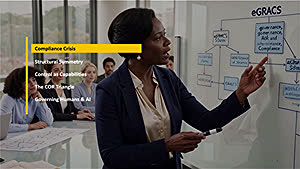
We'll be moving quickly through five key areas today. First, the compliance complexity crisis. Second, unified structural governance symmetry.
Third, redefining controls as capabilities. Fourth, the control opportunity risk triangle. And finally, governing humans and AI.
All right, let's dive into section one, the compliance complexity crisis. I want you to think about your own operations for a second. Are our governance frameworks actually just creating operational bloat? Honestly, for a lot of organizations, the answers are reluctant yes.
We know high-performing teams need a clear structural separation between governance, management, and administration. But what we usually see is governance getting completely bloated. You get procedures inappropriately defining strategy or operational teams accidentally inheriting governance duties.
By stacking all these fragmented frameworks, we just end up with duplicated effort and obscured executive strategy. It's a kind of translation friction that literally feels like trying to run a marathon in quicksand. And if you look at this timeline, you see exactly how we got here.
It is just a history of stacking. We started with corporate audit frameworks back in the 80s and 90s, moved into specialized IT governance like COBIT, layered on security standards like ISO 27001 in the 2000s, and then piled on heavy regulations like GDPR and modern AI acts. You know, the core problem isn't that we lack frameworks.
It's that these frameworks were never designed to operate as a single continuous system. They were just layered on top of each other over decades, leaving us to manage these exhausting complex mapping layers just to make them talk to one another. So this really illustrates the pivot we have to make.
We absolutely must move away from these fragmented historical compliance rules. Instead of adding yet another siloed framework to the stack, organizations need to move toward a unified structural layer that sits seamlessly above all of them. eGRACS doesn't replace your existing standards.
Instead, it acts as this unified translation layer, continuously connecting demand, delivery, and capability. Okay, let's move right into section two, unified structural governance symmetry. To organize controls effectively, EGR CRS uses what's called the golden triangle architecture.
Think of this as a structural governance design, actually inspired by art and cinematography principles that symmetrically balances three core domains, manage demand, deliver solutions, and manage capability. Just like the load-bearing pillars in a high-tech skyscraper, this golden triangle design ensures perfect balance. And the real beauty here is its fractal design.
These tightly coupled control ecosystems expand outward and cascade downward through your strategic, operational, and tactical tiers. It gives you natural traceability right from your board-level vision all the way down to your technical safeguards. And it does it without ever requiring a structural redesign as you scale up.
Notice how eGRACS interacts with what you already have in place. It structurally envelops domain-based models like COBIT, lifecycle models like ITIL, and control models like ISO 27001. So it acts not as a rip-and-replace solution, but as a glowing interconnected digital architecture sitting right at the top.
It provides this overarching structure that keeps your governance continuous, which effectively removes all that immense friction of manual compliance mapping. Which brings us to Section 3, Redefining Controls as Capabilities. Now this is the absolute game-changer for executive efficiency.
The old paradigm, how traditional IT frameworks view the world, treats controls as static artifacts. Think of a written policy, an enabled firewall, a documented procedure. The whole mindset was purely defensive, just trying to prevent bad outcomes.
But eGRACS introduces a totally new paradigm. It recognizes that, hey, a written policy that nobody actually follows isn't a control at all. So it redefines controls as dynamic capabilities.
These are active, persistent behaviors that don't just manage risk, but actually realize opportunity at the exact same time. The artifacts, those are just the evidence. The control itself is the active capability shaping your organization's behavior.
Let me just read this expanded definition because it really shifts the perspective. A control is a defined capability that influences, constrains, enables, or guides the decisions, actions, and omissions of people, systems, and AI-enabled capabilities. That is huge.
It accommodates everything from a human making a strategic choice all the way to an autonomous collaboration in a modern digital ecosystem. This is a framework actually built for the realities of today. All right, Section 4, the Control Opportunity Risk Triangle.
The COR triangle is just a brilliant mental model for us at the board level. It places control, opportunity, and risk at three interconnected vertices. It's a lot like steering a ship.
You don't just use your rudder and sails to avoid crashing into the rocks, right? You use those exact same controls to capture the wind and steer towards your destination even faster. In this tech futurist model, a control is a balanced architectural force. Take CI/CD automation, for example.
That's a control. Sure, it reduces deployment errors, so it's mitigating risk, but it also massively increases your delivery speed and innovation, which means it's enabling opportunity. Under eGRACS, controls are your instruments for dynamic adaptation, not just defensive roadblocks.
And just as a captain learns how a ship handles in rough seas, here is where the model truly comes alive, the continuous learning loop. In traditional governance, learning usually only happens after a really painful audit or some massive incident. But in the EG RCS model, learning is the actual engine of the core triangle.
An action is taken under uncertainty, a consequence emerges, maybe a realized risk, maybe an unexpected opportunity, and that generates learning. This sequence highlights that unexpected successes are honestly just as vital as realized risks. Both of them act as crucial feedback signals, allowing your organization to continuously adapt, evolve, and optimize its control capabilities to hit those ultimate objectives.
Finally, section five, governing humans and AI. I want to pause on this one because at the executive level, this distinction is absolutely critical. We spend so much time focusing on acts of commission, intentionally deploying insecure code or explicitly training a flawed AI model, but eGRACS, which draws heavily on systems theory, recognizes that omission, the failure to act, is also a deeply intentional system behavior.
Think about ignoring AI model drift, failing to review vendor access, or neglecting to patch known vulnerability. These omissions create massive organizational risk. eGRACS uniquely governs both these intentional actions and critical omissions, recognizing that inaction is a behavioral choice that demands strict structural governance.
Because eGRACS treats a control as a dynamic capability that influences both systems and AI, it's uniquely positioned for whatever comes next. It seamlessly shapes the behavior of human AI collaborations and puts constraints on autonomous agentic systems. It ensures you have capabilities in place to monitor continuous model drift and adapt dynamically.
And because that golden triangle architecture is fractal, it scales to meet these new technological demands without you having to do a massive structural redesign. It's actively protecting executive liability in these highly complex automated environments. And this schema essentially represents the climax of structural governance.
Here, you see eGRACS acting as the unified superset, completely seamlessly integrating the controls, guidelines, and reporting requirements of ISO 27001, NIST CSF, GDPR, SOC 2, and HIPAA. It achieves true continuous compliance across every major standard, but without creating all that operational bloat. You are no longer managing five different compliance programs.
You are managing one structurally sound governance architecture that natively satisfies all of them. So I want to leave you with this final provocative thought to consider as you evaluate the scalable future of your enterprise architecture. Traditional frameworks always ask, do we have the right policies to reduce risk? But in today's rapidly shifting digital ecosystem, the real question your board needs to be asking is, do we have the active capabilities to pursue opportunity and adapt to uncertainty? eGRACS provides the exact structure to ensure your answer is a resounding yes.
Thank you so much for joining me for this Executive Explainer.
Subscribe to Our Video Updates
Stay informed with the latest eGRACS tutorials, insights, and strategies by subscribing to our video updates.
Looking for more?
🔍Search🏆Accreditation
eGRACS Accrediation

🤝Calling Consultants
Independent Consultants

🤽Video Explainers
What is eGRACS

🎧Vodcasts
eGRACS Framework Intro
