Keeping Governance Aligned as Regulation Changes
A new regulation shouldn't mean a new project.
GEM, Global Evolution Mapping (Evolve): alignment with changes in standards, regulation, industry conditions and feedback.
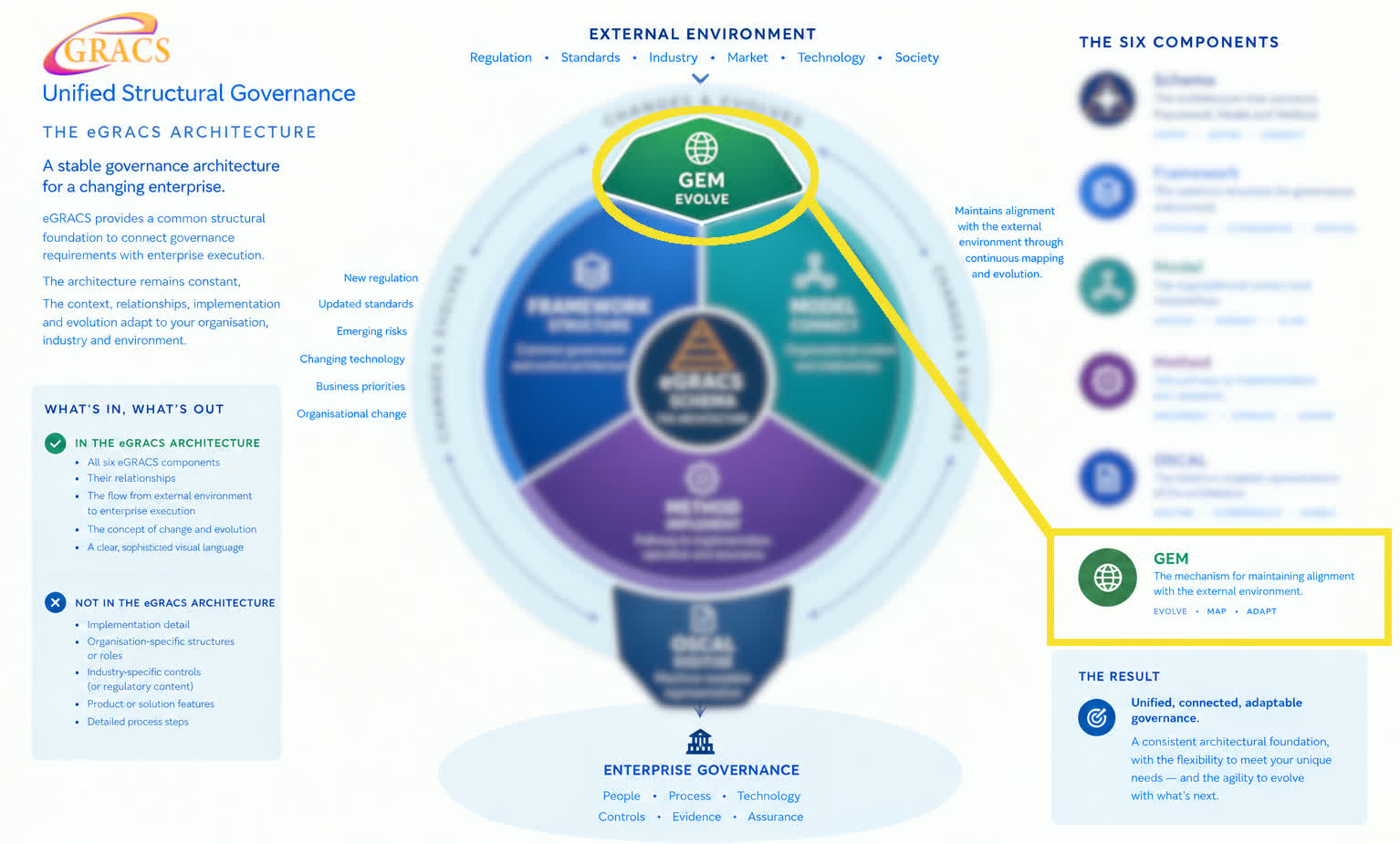
The problem
Every new law, standard update or hard lesson tends to trigger its own retrofit exercise, often with no memory of the last one. Controls that were right when introduced drift out of step with the organisation, its risks and its obligations.
How it works
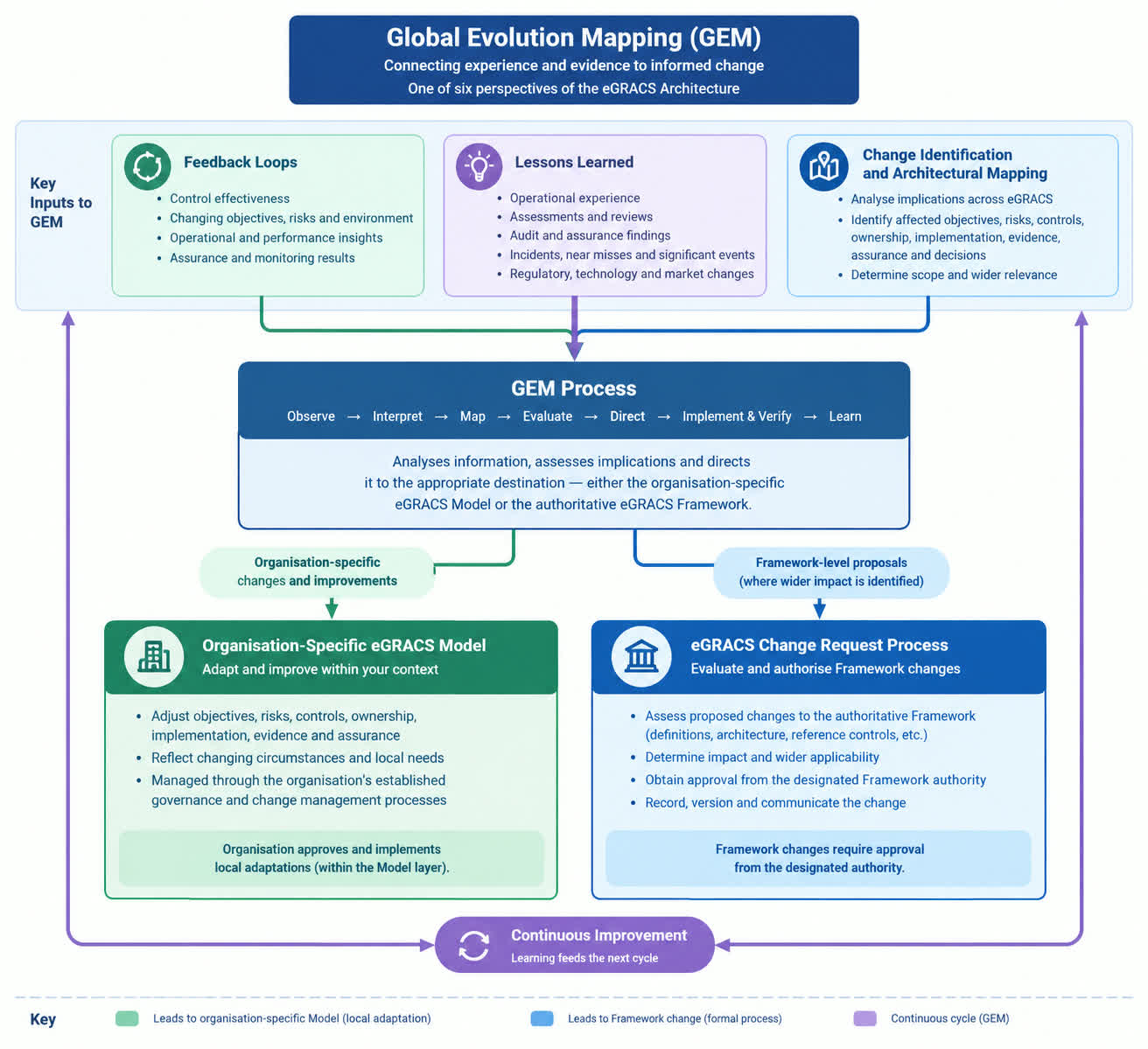
Three inputs
- Feedback loops: ongoing evaluation of whether controls remain suitable.
- Lessons learned: from operations, audits, incidents, near misses and successes.
- Change identification and architectural mapping: using the architecture's relationships to see what a change actually touches.
One cycle
Observe, interpret, map, evaluate, direct, implement and verify, learn. The depth of each step is proportionate to the matter. It isn't seven mandatory administrative stages.
Two destinations
- Adapt your own Model. Your controls, responsibilities or implementation need to change. You decide, through your own change process.
- Propose a Framework change. Where an issue has wider implications, a request goes through a formal change process, and only the designated authority approves a change to the authoritative Framework.
What it looks like in practice
Illustrative, not a case study.
- A new law is related to the existing architecture. Parts may already be addressed, and the remainder is scoped as bounded work rather than a fresh programme.
- An incident teaches the organisation something. That lesson becomes a local improvement in its Model. If the lesson turns out to apply more widely, it can be proposed as a Framework-level improvement.
Who it's for
Compliance and regulatory-change owners, risk leads, and anyone who dreads the words "there's a new requirement."
What it isn't
- Not an interpretation of the law. Reading a regulation stays with you and your advisers. GEM helps you see what your architecture touches and where to direct the response.
- Not a rule that every observation needs a change. Capturing a lesson doesn't authorise one, and many findings need only monitoring or a recorded decision.
- Not a way to alter the Framework locally. Local adaptations stay local.
No registration required. Instant download.