Turn Requirements into How You Actually Run
A requirement can be "met" on paper and mean nothing to the business.
The problem
Rules say what must be achieved. They rarely say who in your organisation owns it, how it's carried out here, or what shows it's working. So requirements get ticked off in one place and mean little in another.
How it works
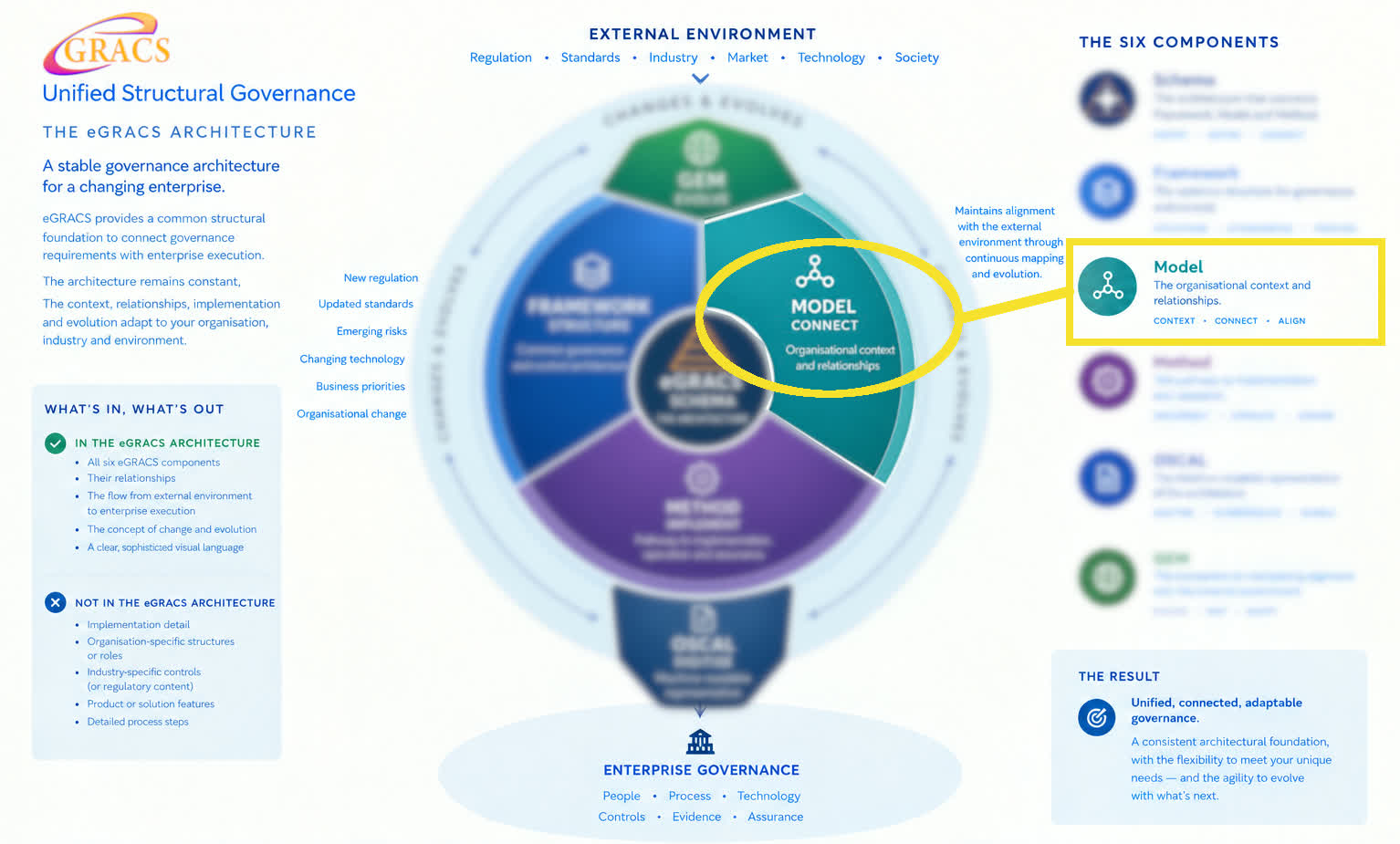
A Model takes the common Framework and records, for one organisation:
- Who owns what. Tiers and domains are mapped to the roles, teams and committees you already have. No new titles or committees are needed.
- What's in scope, honestly. A Control Baseline records what is covered now, what comes later, and what is out, so gaps are visible rather than hidden.
- How requirements are covered. Each external requirement is recorded as directly, partly, jointly or contextually covered, or as a gap with a named owner.
- How eGRACS sits alongside what you have. Three application modes: Replacement (eGRACS becomes your primary internal governance structure, where governance is fragmented), Overlay (a unifying layer over practices that already exist) and Translation Layer (a common language across frameworks that must stay in place). Replacement concerns your internal arrangements only. External obligations still apply.
A completed Model can be expressed as an OSCAL Profile, so tools can consume it directly.
What it looks like in practice
Illustrative, not a case study.
A new privacy obligation arrives. Rather than asking "which policy covers this?", the Model traces it to the objective it supports, the risk it manages, the person accountable, how it's implemented and what evidence exists: one connected view instead of five places to check.
Connected dashboards
Because the Model records ownership, relationships and evidence at every tier, it holds what a connected governance dashboard needs: executive views linked down to the management and operational detail beneath them. This is a capability the Model enables, built in your own or a partner's tooling. It is not a dashboard product that eGRACS supplies.
Who it's for
Implementation leads, consultants and GRC practitioners, the people who have to make eGRACS fit a specific organisation.
What it isn't
- A Model adapts how the Framework is applied. It never changes what the Framework defines. Local changes stay local.
No registration required. Instant download.