Stop Governance Changes Forcing Rewrites
Blur the rules that apply everywhere with how one organisation works, and every change ripples. The eGRACS Schema keeps them separate and connected.
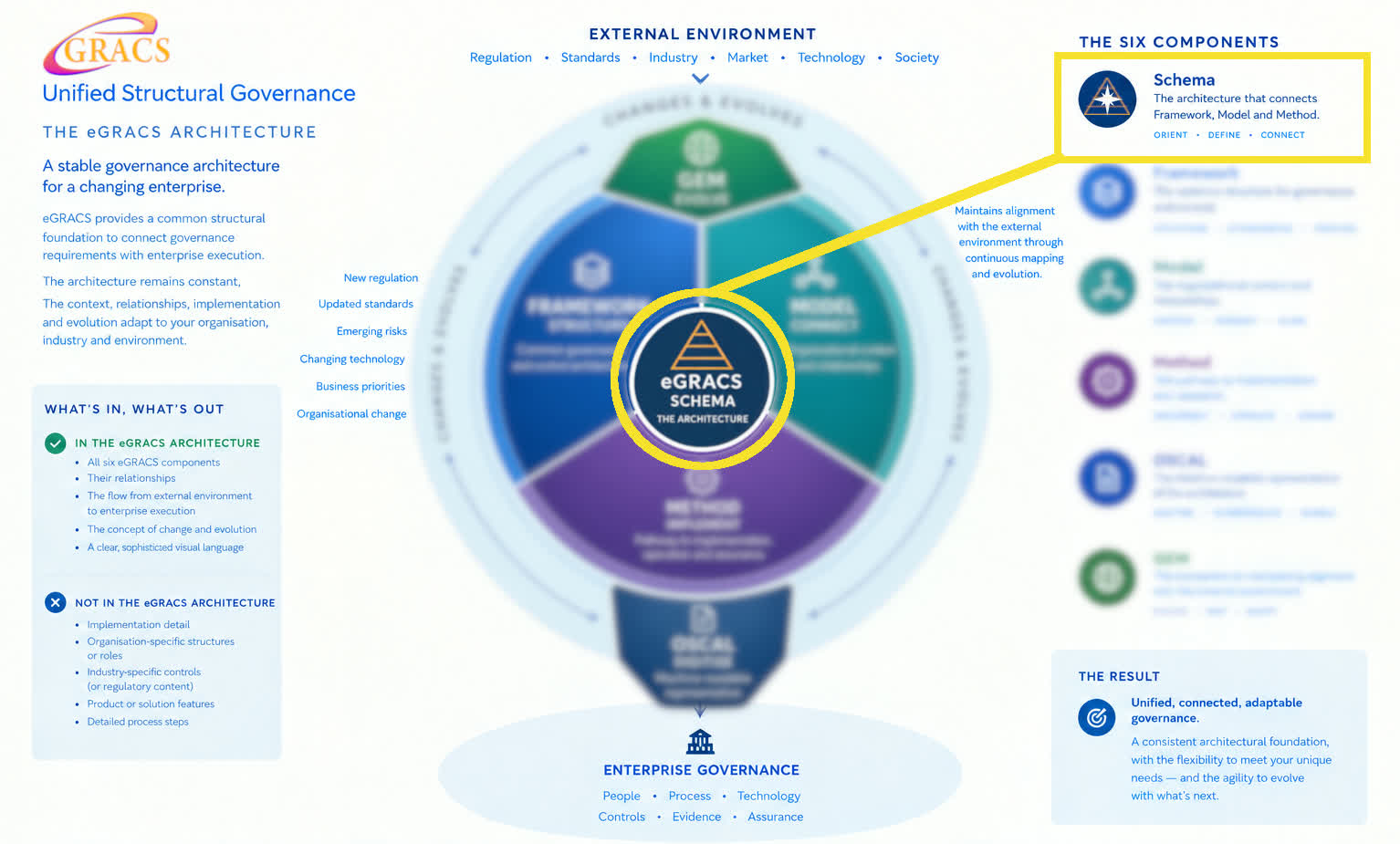
Why does every governance change force a rewrite?
Most approaches blur two different things: the rules that apply everywhere, and the way one organisation actually works. So when either changes (a new regulation, a reorganisation, a new system) the other gets dragged along and rewritten with it.
How it works
- Framework: the what. The common governance and control architecture, shared by every organisation that uses eGRACS.
- Model: the for whom. How that architecture is adapted to one organisation's roles, risks and regulatory environment.
- Method: the how. The pathway that puts the Model into practice, operates it and keeps improving it.
Two supporting mechanisms work across all three: the OSCAL Catalog puts the architecture into machine-readable form, and GEM keeps it aligned with change. They are not a fourth step in the chain.
What it looks like in practice
Illustrative, not a case study.
A 50-person startup and a 50,000-person bank can run the same Framework. Their Models will differ (roles, scale, risk appetite) and so will their Methods (pace, tooling). The architecture doesn't change. What it means for each organisation does.
Who it's for
Anyone meeting eGRACS for the first time. If you read only one page, read this one.
What it isn't
- The Schema isn't a separate thing to implement. It is the relationship between the other components.
Common questions
Are the Model and the Framework the same thing?
Where do OSCAL and GEM fit?
Resources
No registration required. Instant download.